VR Training Effectiveness: What the Meta-Analyses Actually Measure
Try Omni 2, the free-forever versionNo credit card · instant activation

Key takeaways
- VR training effectiveness is real but modest. Pooled effects on learning outcomes land between 0.38 and 0.54 in recent meta-analyses: a consistent, unspectacular advantage.
- Engagement is where VR wins biggest. One meta-analysis measures a large effect on learner engagement (0.85).
- The most-quoted vendor number is narrow. "4x faster" comes from one PwC study of one soft-skills course, and drops to 3x once headset onboarding is counted.
- The most-quoted training number of all has no source. The learning pyramid (75% / 5%) has no traceable study behind it.
- The bottleneck is the trainer in the room, not the technology. A 2024 doctoral thesis on 155 trainers finds their main fears are losing control of the session flow and losing learners' attention.
- What trainers lack is a way to run the session. In field reports from French training centers, the recurring difficulty is seeing and controlling every headset at once: one university calls screen monitoring complicated and is looking for a system that lets teachers control the experiences.
Is VR Training Effective? The Short Answer
On average, yes, modestly. Coban, Bolat and Goksu (2022) pooled 105 effect sizes from 48 studies of immersive VR and reported an overall effect of 0.38: a small-to-moderate advantage over whatever learners were compared against.
That number is worth taking seriously because it is unglamorous. It says VR usually beats the alternative it was tested against. It says nothing about whether your program will work, because none of those studies compared a well-run session with a chaotic one.
small0.5
moderate0.8
large
How to read effect sizes: 0.2 = small, 0.5 = moderate, 0.8 = large.
VR Training Statistics: Which Figures Hold Up
Two numbers show up in almost every VR training deck. One is real but narrow. The other has no source.
The PwC 2020 "4x Faster" Study: Real, But Narrow
PwC trained new managers on inclusive leadership (unconscious bias) between February 2019 and January 2020, delivering the same course three ways: classroom, e-learning and VR. According to PwC:
VR learners completed training 4x faster than classroom learners;
once first-time users' time to be fitted and learn the headset is counted, they were still 3x faster;
they felt 3.75x more emotionally connected to the content than classroom learners;
they were 4x more focused than e-learners and 1.5x more than classroom learners;
their confidence to act on what they learned rose 40% vs. classroom and 35% vs. e-learning;
VR reached cost parity with classroom training at 375 learners, and with e-learning at 1,950.
Three caveats matter more than the headline. It is a corporate study, not peer-reviewed research. It covers one soft-skills topic. And the drop from 4x to 3x is onboarding time: the point of this whole article in miniature.
The Learning Pyramid (75% / 5%): No Scientific Basis
"We remember 5% of a lecture, 10% of what we read, 75% of what we practice." It is quoted constantly, including in VR pitches, to imply that immersion beats listening.
There is no study behind those percentages. Letrud and Hernes traced how the figures spread through academic publications without a primary source. Will Thalheimer reached the same conclusion: the numbers are usually attributed to Edgar Dale's "cone of experience", but Dale never assigned retention percentages to anything. A review in Medical Education calls the pyramid a myth with no evidence.
What is true: the intuition that people learn better by doing than by listening. Freeman et al. (2014), a meta-analysis of 225 studies in undergraduate science courses, found students in traditional lectures were 1.5 times more likely to fail than students in courses with active learning. The trend is real; the percentages are made up.
Does VR Training Work? What Recent Meta-Analyses Measure
| Study | What they looked at | What they found (in plain words) | The catch |
|---|---|---|---|
| Coban et al. (2022) | 48 studies, 105 effect sizes, immersive VR | A small-to-moderate gain on learning (0.38): moderate vs. traditional teaching (0.54), small vs. computer-based learning (0.30). | An average across subjects and ages; nothing about how sessions were run. |
| Hong, Shi & Dogan (2025) | VR and human memory | A moderate effect on memory (0.54). | Memory is not job performance. |
| Chen et al. (2024) | 15 studies, learner engagement | A large effect on engagement (0.85), stronger with headsets (0.93) than on screens (0.55), and for procedures (0.97) than for theory (0.52). | Engagement, not learning outcomes. |
| Yang et al. (2024) | 37 studies, practical skills in science and engineering | A moderate gain in practical skills (0.48), largest for medical students (0.79). | Not significant for engineering or science students alone; screen-based VR did no worse than headsets. |
| Hongthong et al. (2025) | 21 studies, 1,527 participants, medical education | A moderate overall gain (0.51): clear for skills (0.69), smaller for knowledge (0.35), none for motivation. | 87% of the variation sits between studies, and the authors used a fixed-effect model despite it: treat the pooled figure with care. |
| World Bank (2021) | 31 studies, 92 experiments | VR more effective than traditional training on average, and up to 30% more efficient (time, materials or errors) per hour of training. | The efficiency figure rests on 12 experiments, mostly surgery and welding; the average learning gain is about 3% per hour, and the authors warn against generalizing. |
| Krokos et al. (2018) | 40 participants, one memory task | 84% accurate recall in a headset vs. 75% on a desktop. | A single lab task; nothing about transfer to the job. |
How to read these numbers
- These are averages, not forecasts. A gain of 0.38 is the middle of a spread that also contains failures.
- The comparison group matters as much as the headset. VR looks better against traditional teaching (0.54) than against computer-based learning (0.30).
- Big averages hide big differences. In two of these meta-analyses, most of the variation sits between studies, not within them.
- None of these syntheses controls for delivery. No study in the table separates a well-facilitated session from a chaotic one.
Benefits of VR Training: Where It Works, Where It Doesn't
Where the evidence is strongest.
The World Bank finds the most promising results in health and safety, engineering and technical education: procedures that are dangerous, expensive or hard to repeat, practiced again and again in a standardized environment, without risk.
Technical gestures: everything done with the hands. It is in practice that VR shows its clearest gains. In medical education, the effect is stronger on skills (0.69) than on knowledge (0.35) (Hongthong et al., 2025), and the highest gain in practical skills measured by Yang et al. (2024) concerns medical students (0.79). In vocational training, the sources cite spray painting, using a saw bench and welding (France Immersive Learning guide), as well as simulators for industrial painting, wood cutting, electrical maintenance and boilermaking (Jordahn, 2024). The benefit is the same each time: repeating the gesture as many times as needed without using up paint, metal or wood, and, on some simulators, recording the speed, angle or force of the gesture (Jordahn, 2024, p. 46).
One caveat: studies on trade-specific gestures (construction, industry) remain rare; most meta-analyses focus on medicine, STEM and safety (Jordahn, 2024, p. 49).
Where it adds less.
Purely theoretical content. The World Bank finds no clear pattern in general education; in one study it cites (Parong & Mayer, 2018), a slideshow outperformed immersive VR on a biology test.
Overloaded environments. Adding immersion to a science lab simulation increased presence but reduced learning (Makransky, Terkildsen & Mayer, 2019).
Experienced practitioners. In cataract surgery training, experienced surgeons showed no significant gain, unlike novices (Skou-Thomsen et al., 2017, cited by the World Bank).
Cost is conditional. The World Bank states that VR cost-effectiveness is not always assured: it requires software, equipment, maintenance, support and updates.
VR Training Examples: What Walmart, Bank of America and UPS Report
Three large US programs are cited again and again. Here is what the companies themselves published.
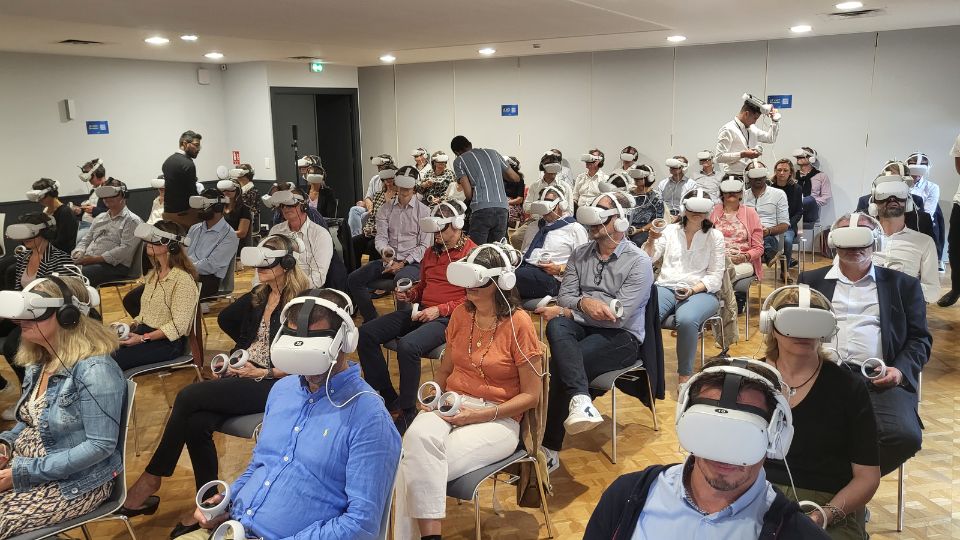
Walmart (2018). More than 17,000 Oculus Go headsets shipped to US stores, four per Supercenter and two per Neighborhood Market and discount store, giving more than 1 million associates access to VR training. The 45+ modules cover new technology, soft skills such as empathy and customer service, and compliance. Walmart reported test scores 10 to 15% higher in its pilot. The modules are self-directed: associates can train at any time, without an instructor.
Bank of America (2021). VR training rolled out to nearly 4,300 financial centers for about 50,000 employees, with 20 simulations on client relationships, difficult conversations and listening with empathy. In a pilot with 400 employees, 97% said they felt more comfortable performing their tasks.
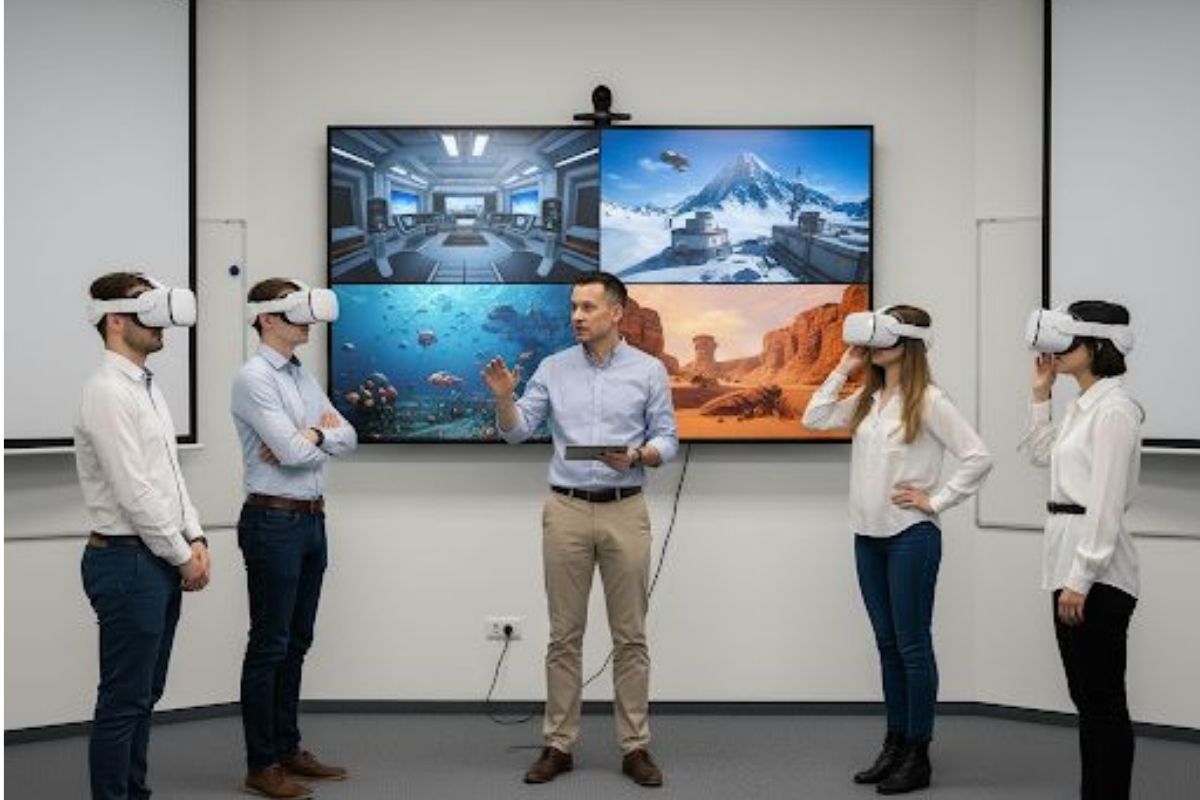
UPS (2021). Drivers practice identifying and handling road hazards in a VR simulation at UPS Integrad training facilities, with rollout planned across all Integrad sites; UPS also built a mobile training academy in two 53-foot trailers.
How to read these examples. These are company announcements, not independent evaluations, and the figures are self-reported. They show two models: self-service training on headsets left in stores (Walmart), and training in dedicated facilities (UPS). What none of them describes is how a session actually runs, which is exactly where the research has a gap.
VR Training Research: The 4 Conditions That Decide the Outcome
The reference model of immersive learning (CAMIL, Makransky & Petersen, 2021) explains that immersion works through presence and agency, via six factors: interest, motivation, self-efficacy, embodiment, cognitive load and self-regulation. In practice, four conditions keep coming back.
Short sessions. Cybersickness increases on average with exposure time. A 2026 meta-analysis of 28 headset studies gives exploratory reference points around 26 and 32 minutes, with no universal threshold: susceptibility varies widely between people. Plan sequences of about twenty minutes, shorter for first-timers, and stop anyone who feels unwell rather than encouraging them to push through.
Active content without overload. VR's value is action. A spectacular but passive environment adds cognitive load the task does not need (Makransky et al., 2019; Parong & Mayer, 2018).
Real onboarding time. The novelty effect is documented: in first VR experiences, fascination with the headset lowers learning outcomes (Miguel-Alonso et al., 2024), and learning improves as learners become familiar with the environment (longitudinal study, IEEE TVCG, 2025). PwC's own numbers show the same thing: 4x faster becomes 3x once onboarding is counted.
A trainer who stays in control of the group. Once learners are inside headsets, the trainer's usual tools (eye contact, a raised hand, walking over) stop working. For a long time this was the condition with the thinnest evidence base. A 2024 French doctoral thesis now documents it directly: see the next section.
Why VR Training Programs Fail to Scale: The Trainer Is the Missing Variable
Scaling happens at two levels.
Fleet level: hundreds or thousands of headsets enrolled, configured and updated by IT, the job of device management platforms (MDM).
Session level: one trainer, one group, one room, often on Wi-Fi that does not cooperate. This is where a program is actually judged.
Most organizations don't need to manage 5,000 headsets. They need tomorrow morning's session to go well.
In 2024, Quentin Jordahn defended a doctoral thesis in psychology at Université Paris Cité on exactly this question: what determines whether trainers and training centers actually integrate immersive learning. The thesis was funded under France's CIFRE industry-research scheme by Mimbus, a VR training simulator publisher. Its four studies are exploratory, on modest samples, and based on what trainers report, as the author himself notes.
Headsets Bought, Headsets Unused
The thesis starts from an observation Mimbus made among its own customers: some of its simulators had never been used even though they were in working order, and fewer than 10% of trainers with access to its management platform used it for anything other than activating licenses. The simulators were mostly brought out for open days and trade shows, not built into courses. This is a company observation reported in the thesis, not a study result, but it puts a name on a familiar pattern: owning headsets is not the same as using them.
What Trainers Actually Fear About VR Sessions
In a survey of 155 trainers (half of whom had never used a VR device), the fears that held up in the statistical analysis were all about running the class:
"I'm afraid of no longer controlling how my course unfolds";
"I'm afraid of losing my learners' attention";
"I'm afraid of my course losing its seriousness".
Fears such as a learner getting hurt did not hold up. In the thesis's model, these fears lower trainers' confidence in their own ability to use VR, and that confidence is what predicts whether they intend to use it.
A Researcher's Warning About the Evidence
The author draws a conclusion that matters for every effectiveness figure on this page: the lack of support and skills among trainers may also explain the sometimes contradictory results on the effectiveness of VR, and future studies should check whether the trainers using it have accepted, mastered and integrated it (Jordahn, 2024, p. 196). The World Bank meta-analysis, for its part, measures test scores, skills and efficiency per hour, and contains no passage on live facilitation.
The research measures whether the medium works. Almost nobody measures whether the session works.
Training Trainers Helps, But It Isn't Enough
In a fourth study, 45 trainers were compared, 26 of whom took a three-day course on running VR sessions. Their confidence and perceived usefulness rose markedly and their anxiety fell; their intention to use VR rose only slightly, not significantly. The author's conclusion: training is one action among others, and trainers need ongoing support to make these tools part of their practice.
How Training Centers Actually Run VR Sessions: Field Reports
There is no research standard for running a VR session. There are field practices. The France Immersive Learning guide (2023, based on a qualitative survey of about 200 organizations) collects several:
| Organization | How the session is run | Source (guide page) |
|---|---|---|
| Compagnons du Devoir, metalwork and piping institute | Small groups of 4 to 5 at most: one learner in the headset, one helping, three following on a monitor. Beyond that, attention drops and the trainer's job gets harder. | p. 159 |
| BPCE (French banking group) | Building evacuation training for 5,000 employees, in sessions of 8 people immersed at the same time, led by a trained moderator. | p. 109, 135 |
| D'un Seul Geste × BlaBlaCar | One-hour sessions for 2 to 4 people, guided by an instructor: headset tutorial, 30 minutes in VR, 10 minutes of realistic scenario, 20 minutes of debrief. | p. 139 |
| CESI engineering school | 20-minute mixed reality sessions with retransmission screens to guide learners. Challenges named: managing the headsets and fluidity depending on network quality. | p. 131 |
| Université Lyon 1 | Monitoring users' screens is described as complicated in an educational setting; the team is working with standalone headset kits and an app management system so teachers can control the experiences. | p. 165 |
| AFPA (French adult vocational training agency) | Adoption is not spontaneous: if instructors don't assist and encourage learners, the platform is of little use. | p. 147 |
What these practices share: small groups, short sequences, a screen so that someone can follow what happens in the headset, and a trainer who guides.
Note: the guide is published by an association and was funded by an unconditional donation from Meta; these are testimonials, not studies.
The real issue is session management. In these testimonials, the difficulty does not come from the content: it comes from running the group. The Compagnons du Devoir have learners follow a single headset on a monitor. CESI names headset management and network quality. Université Lyon 1 describes screen monitoring as complicated and is looking for a system that lets teachers control the experiences (the same problem schools face with VR in the classroom). What keeps coming back is that trainers lack a simple way to see and control every headset at once.
What Trainers Lose Control Of During a VR Session
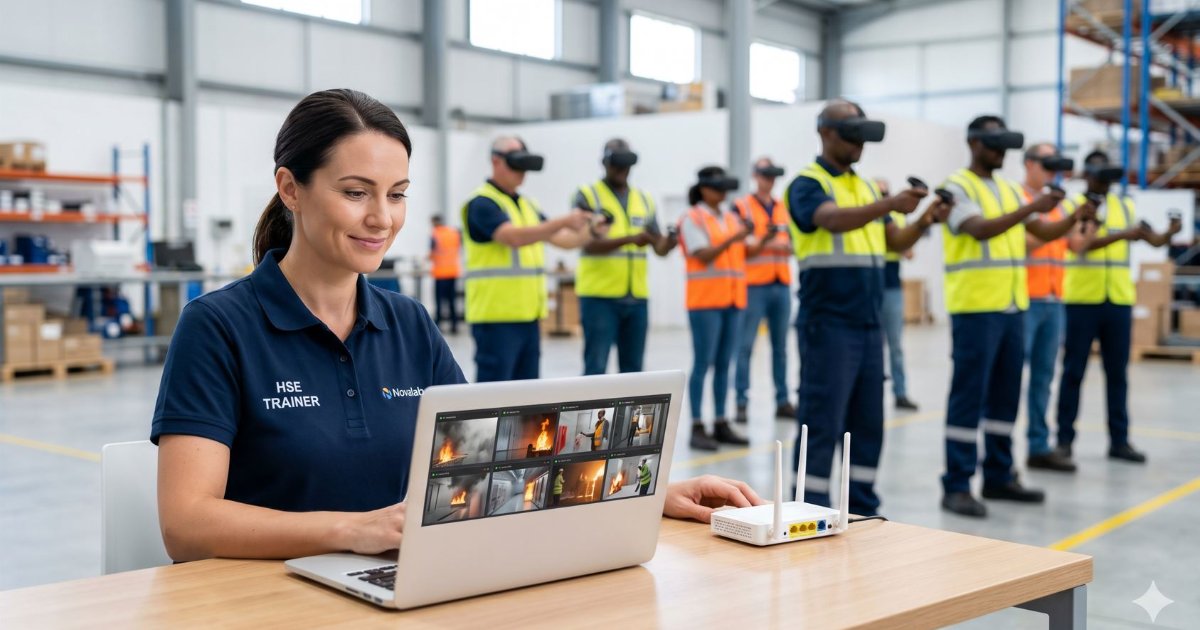
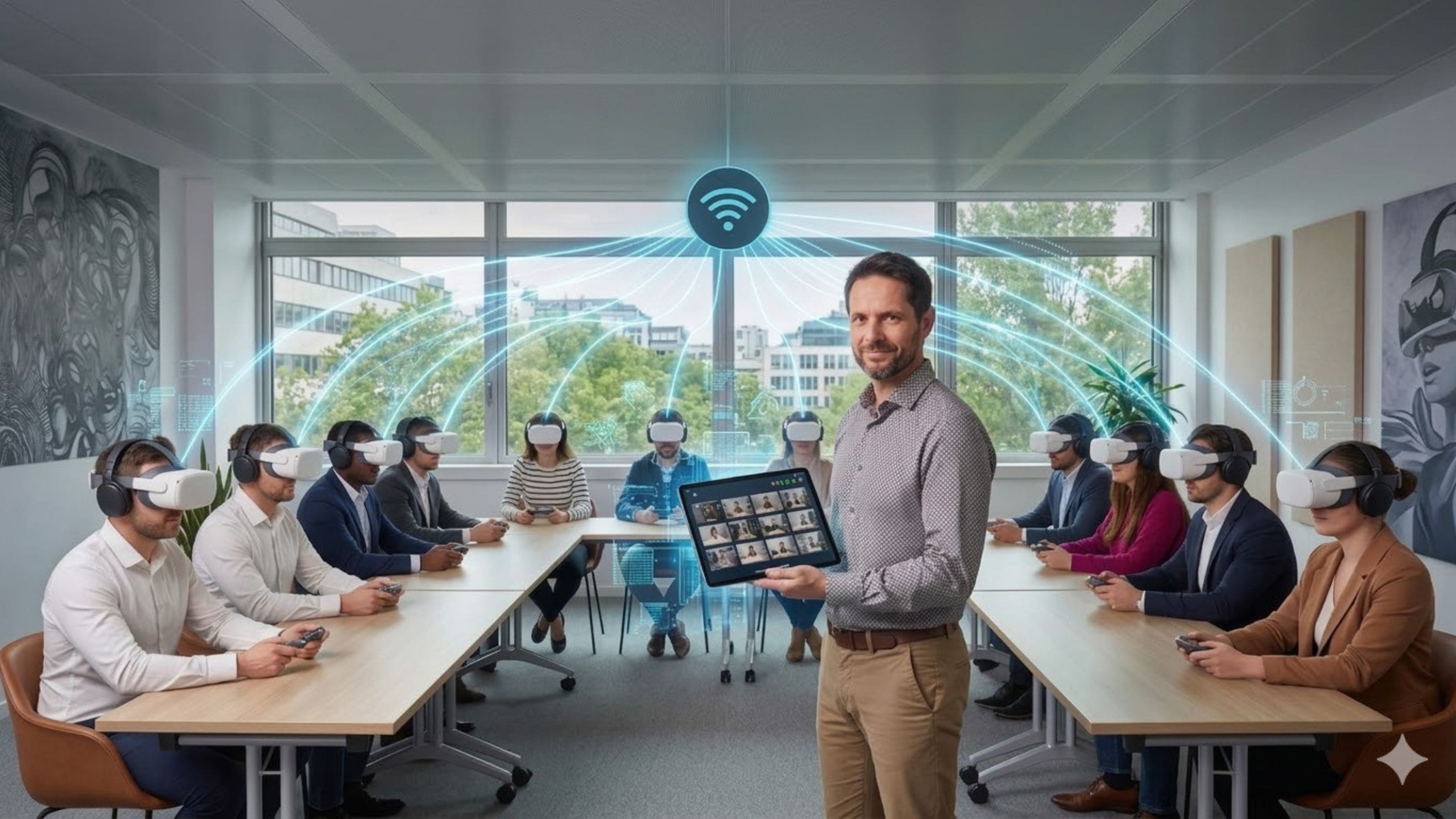
The thesis shows that training reduces trainers' fears. But on the day of the session, what matters is what the trainer can see and do in the room. Here are the eight moments when trainers lose control if they have no tool to run and monitor the session, and what OmnicastVR does at each.
1Starting the session
The problem. Each learner hunts for the app in the headset menu, and the first minutes of a twenty-minute sequence disappear. This is the fear trainers name first: losing control of how the course unfolds.
What OmnicastVR does. Launches the same app on every headset at once, up to 16, from one screen. The group starts together.
2Knowing who is actually in the session
The problem. A headset on a head looks like a headset in use. Trainers often discover at the end that someone never really started.
What OmnicastVR does. Shows, headset by headset, whether it is connected and whether the app is running, right on the global streaming view of all headsets.
3Seeing what learners see
The problem. One pair of eyes for a whole group, and the second fear trainers name: losing learners' attention. Université Lyon 1 describes monitoring screens as complicated; the Compagnons du Devoir have the waiting learners follow one headset on a monitor.
What OmnicastVR does. Streams every headset's screen live to one dashboard, with zoom on a single headset. The trainer can guide out loud ("look to your left") and spot who has stopped progressing.
4Keeping the group on the same step
The problem. A slow start or a mis-click puts two or three learners a step behind, and pulling them forward usually means stopping everyone.
What OmnicastVR does. Relaunches the app on one headset or on all of them, without ending the session.
5Unblocking one learner without stopping the group
The problem. One learner is stuck. The usual fix, restarting everyone, costs the whole group's progress.
What OmnicastVR does. Stops or restarts the app on that headset only, while the others keep working.
6A headset drops out mid-session
The problem. A battery runs low, the network blinks, a headset disconnects, and one device fault turns into a group problem.
What OmnicastVR does. The stream comes back automatically when the headset is active again. Meanwhile its tile simply stays black on the grid: no need to stop the other streams.
7Running without reliable Wi-Fi or IT support
The problem. CESI names network quality among its challenges; AFPA had to have network ports opened on its computers, something it says should be anticipated from the start. The World Bank lists connectivity and IT support among the conditions often missing.
What OmnicastVR does. Works with or without internet, on a simple local Wi-Fi network, with streaming bitrate adjustable from 2 to 10 Mbit/s. Nothing to install on the headsets (Meta Quest only needs developer mode enabled once), no login for the trainer, and one tool for Meta Quest, Pico and HTC Vive.
8Ending the session and putting headsets away
The problem. Stopping sixteen headsets means sixteen trips around the room, then cleaning, storing and charging them, often by the trainer alone.
What OmnicastVR does. Stops the apps or turns off every headset in one click. Cleanup gets shared: learners wipe their own headset, put it back in its slot and plug it in to charge.
Summary
| The trainer's problem | What OmnicastVR does |
|---|---|
| Losing control of how the course starts | Same app launched on up to 16 headsets at once |
| Not knowing who really started | Per-headset status: connected, app running |
| Losing learners' attention | Live screen of every headset on one dashboard, zoom on one |
| The group drifts across steps | Relaunch the app on one headset or all |
| One stuck learner stalls the room | Stop or restart that headset's app only |
| A headset drops out | Stream returns automatically; the others keep running |
| Unreliable Wi-Fi, no IT support | With or without internet; nothing to install on headsets; no login |
| A long end of session | Stop apps or turn off every headset in one click; learners clean and charge |
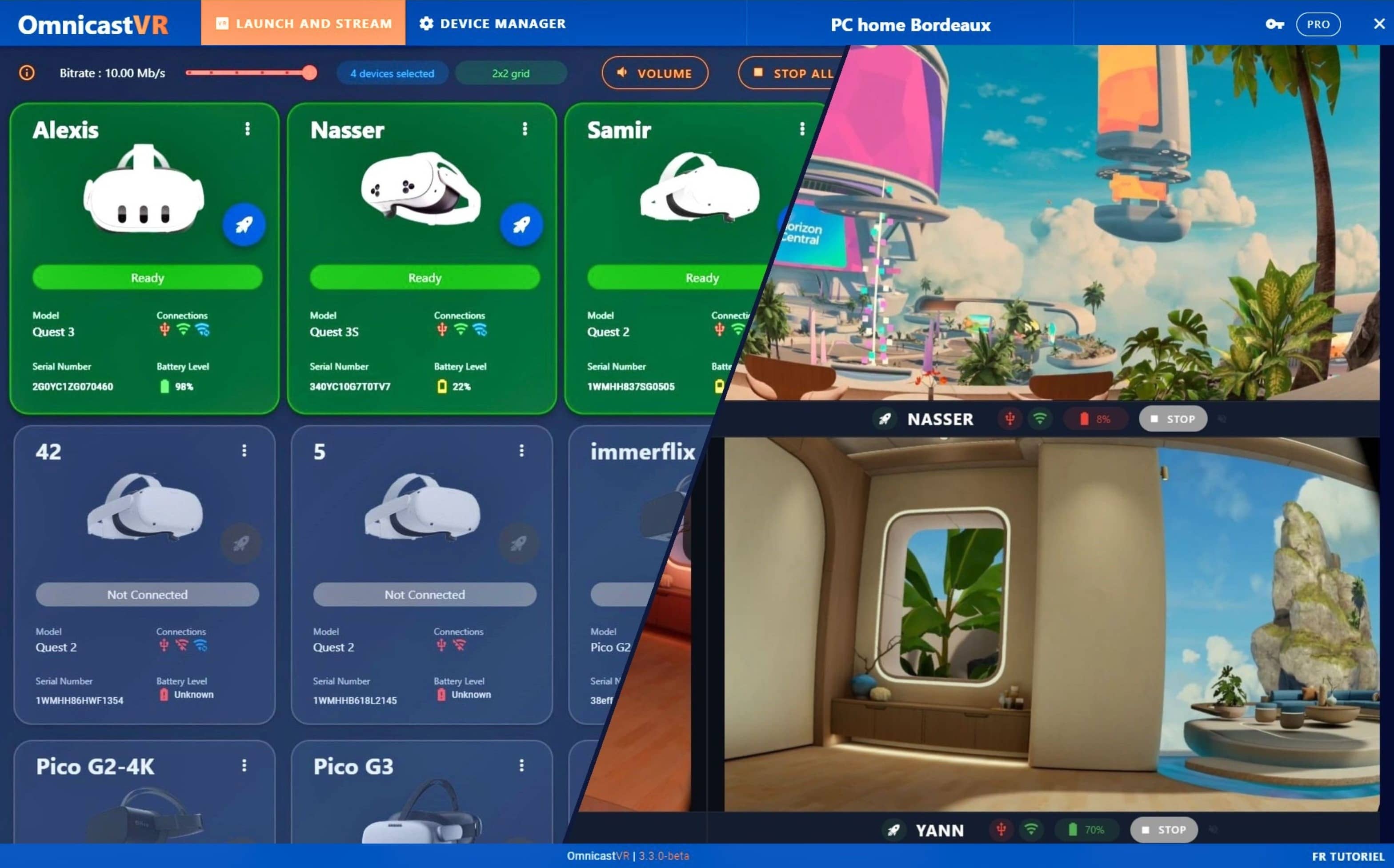
OmnicastVR is free forever for 1 to 2 headsets. Beyond that, licenses are monthly or annual.
Frequently Asked Questions
On average, yes, by a small-to-moderate margin. Recent meta-analyses report effects between 0.38 and 0.54 on learning outcomes, and a large effect on engagement (0.85). "Effective on average" and "effective in your program" are different claims; the difference is usually delivery.
Coban et al. (2022) found a larger advantage over traditional instruction (0.54) than over computer-based learning (0.30). PwC's 2020 corporate study reported VR learners completing a leadership course 4x faster than classroom learners, or 3x once headset onboarding is included.
No. Those percentages have no traceable primary study, and Edgar Dale's cone of experience, to which they are often attributed, contained no retention figures. Research does support the broader idea that active learning beats lecturing (Freeman et al., 2014).
It is real data, and narrow: a corporate study of one inclusive-leadership course, not peer-reviewed research. The 4x figure becomes 3x once first-time users' headset setup and orientation time is counted.
Walmart gave more than 1 million associates access to VR training through 17,000+ headsets in its US stores (2018); Bank of America rolled it out to nearly 4,300 financial centers for about 50,000 employees (2021); UPS uses VR hazard-recognition training for drivers at its Integrad facilities (2021). These figures are company-reported.
Cybersickness increases with exposure time. A 2026 meta-analysis of 28 studies gives reference points around 26 to 32 minutes, with no universal threshold. Sequences of about twenty minutes, shorter for first-timers, with an immediate stop for anyone who feels unwell, are a safe starting point.
There is no research standard. Field practices range from 2 to 4 people (D'un Seul Geste × BlaBlaCar) and groups of 4 to 5 with one learner in the headset and the others following on a monitor (Compagnons du Devoir) to 8 people immersed at once with a trained moderator (BPCE).
A 2024 French doctoral thesis starts from that observation: simulators left unused and brought out mainly for open days. In its survey of 155 trainers, the fears that held up were losing control of the course flow, losing learners' attention and losing the course's seriousness; these fears lower trainers' confidence, which predicts whether they intend to use VR.
Rarely. The strongest results are in health and safety, engineering and technical training, and in tasks that are expensive, dangerous or hard to repeat. For purely theoretical content and for experienced practitioners, the advantage narrows or disappears.
Because scaling has two levels. Fleet management, provisioning hundreds of devices, is well served by MDM platforms (how MDM and OmnicastVR differ). Session control, one trainer keeping one group in step, is what actually breaks, and it is the part the research has largely left unmeasured.
Plug in. Control. Supervise. That's it.
Try Omni 2, the free-forever versionNo credit card · instant activation
Learn more: VR training use cases · All OmnicastVR features
Sources
- PwC (2020), Study into the effectiveness of VR for soft skills training — https://www.pwc.co.uk/services/technology/immersive-technologies/study-into-vr-training-effectiveness.html
- PwC Middle East, Solving for skills training with Virtual Reality (source of the 3x figure, citing PwC's 2020 study) — https://www.pwc.com/m1/en/services/consulting/technology/emerging-technology/solving-for-skills-training-with-virtual-reality.html
- Coban, M., Bolat, Y. I., & Goksu, I. (2022). The potential of immersive virtual reality to enhance learning: A meta-analysis. Educational Research Review, 36, 100452 — https://doi.org/10.1016/j.edurev.2022.100452
- Hong, Y. A., Shi, X., & Dogan, S. (2025). A systematic review of virtual reality technology and human memory augmentation. International Journal of Human–Computer Interaction — https://doi.org/10.1080/10447318.2025.2530080
- Chen, J., Fu, Z., Liu, H., & Wang, J. (2024). Effectiveness of virtual reality on learning engagement. International Journal of Web-Based Learning and Teaching Technologies, 19(1) — https://doi.org/10.4018/IJWLTT.334849
- Yang, C., et al. (2024). The impact of virtual reality on practical skills for students in science and engineering education: a meta-analysis. International Journal of STEM Education, 11, 28 — https://doi.org/10.1186/s40594-024-00487-2
- Hongthong, B., Jantakoon, T., & Trisupakitti, S. (2025). The effectiveness of virtual reality in medical education: A meta-analysis of knowledge, skills, and motivation outcomes. Higher Education Studies, 15(4) — https://doi.org/10.5539/hes.v15n4p101
- Angel-Urdinola, D., Castillo-Castro, C., & Hoyos, A. (2021). Meta-Analysis Assessing the Effects of Virtual Reality Training on Student Learning and Skills Development. World Bank Policy Research Working Paper 9587 — https://documents1.worldbank.org/curated/en/204701616091079027/pdf/Meta-Analysis-Assessing-the-Effects-of-Virtual-Reality-Training-on-Student-Learning-and-Skills-Development.pdf
- Krokos, E., Plaisant, C., & Varshney, A. (2018). Virtual memory palaces: immersion aids recall. Virtual Reality, 23, 1–15 — https://doi.org/10.1007/s10055-018-0346-3
- Parong, J., & Mayer, R. E. (2018). Learning science in immersive virtual reality. Journal of Educational Psychology, 110(6), 785–797 — https://doi.org/10.1037/edu0000241
- Makransky, G., Terkildsen, T. S., & Mayer, R. E. (2019). Adding immersive virtual reality to a science lab simulation causes more presence but less learning. Learning and Instruction, 60 — https://doi.org/10.1016/j.learninstruc.2017.12.007
- Makransky, G., & Petersen, G. B. (2021). The Cognitive Affective Model of Immersive Learning (CAMIL). Educational Psychology Review, 33, 937–958 — https://doi.org/10.1007/s10648-020-09586-2
- Miguel-Alonso, I., Checa, D., Guillen-Sanz, H., & Bustillo, A. (2024). Evaluation of the novelty effect in immersive Virtual Reality learning experiences. Virtual Reality, 28 — https://doi.org/10.1007/s10055-023-00926-5
- From Novelty to Knowledge: A Longitudinal Investigation of the Novelty Effect on Learning Outcomes in Virtual Reality (2025). IEEE TVCG — https://doi.org/10.1109/TVCG.2025.3549897
- Exposure duration and cybersickness in head-mounted displays: A meta-analysis of threshold effects across virtual and extended reality (2026) — https://www.sciencedirect.com/science/article/pii/S266695012600101X
- Letrud, K., & Hernes, S. (2016). The diffusion of the learning pyramid myths in academia: an exploratory study. Journal of Curriculum Studies, 48(3), 291–302 — https://www.tandfonline.com/doi/abs/10.1080/00220272.2015.1088063
- Thalheimer, W. (2015). Mythical retention data & the corrupted cone. Work-Learning Research — https://www.worklearning.com/2015/01/05/mythical-retention-data-the-corrupted-cone/
- Edgar Dale's Pyramid of Learning in medical education: Further expansion of the myth. Medical Education (2019) — https://doi.org/10.1111/medu.13813
- Freeman, S., et al. (2014). Active learning increases student performance in science, engineering, and mathematics. PNAS, 111(23) — https://doi.org/10.1073/pnas.1319030111
- Jordahn, Q. (2024). Études sur les facteurs déterminants à l'implémentation de l'Immersive Learning dans l'activité des formateurs et des organismes de formation [Doctoral thesis in psychology, Université Paris Cité; CIFRE with Mimbus] — full text (PDF, hosted with permission): https://omnicastvr.com/docs/va-jordahn-quentin.pdf · HAL record: https://theses.hal.science/tel-05458194v1 · https://theses.fr/2024UNIP7341
- France Immersive Learning (2023). Learning everything there is to know about immersive learning (English adaptation of the French guide; funded by an unconditional donation from Meta) — full text (PDF, hosted with permission): https://omnicastvr.com/docs/fil-immersive-learning-guide-en.pdf · publisher: https://franceimmersivelearning.fr/
- Walmart (2018). How VR is transforming the way we train associates — https://corporate.walmart.com/news/2018/09/20/how-vr-is-transforming-the-way-we-train-associates
- Bank of America (2021). Bank of America is First in Industry to Launch Virtual Reality Training Program in Nearly 4,300 Financial Centers — https://www.prnewswire.com/news-releases/bank-of-america-is-first-in-industry-to-launch-virtual-reality-training-program-in-nearly-4-300-financial-centers-301395210.html
- UPS (2021). Virtual reality helping to create safety for UPS drivers — https://about.ups.com/us/en/our-stories/innovation-driven/virtual-reality-helping-to-create-safety-for-ups-drivers.html